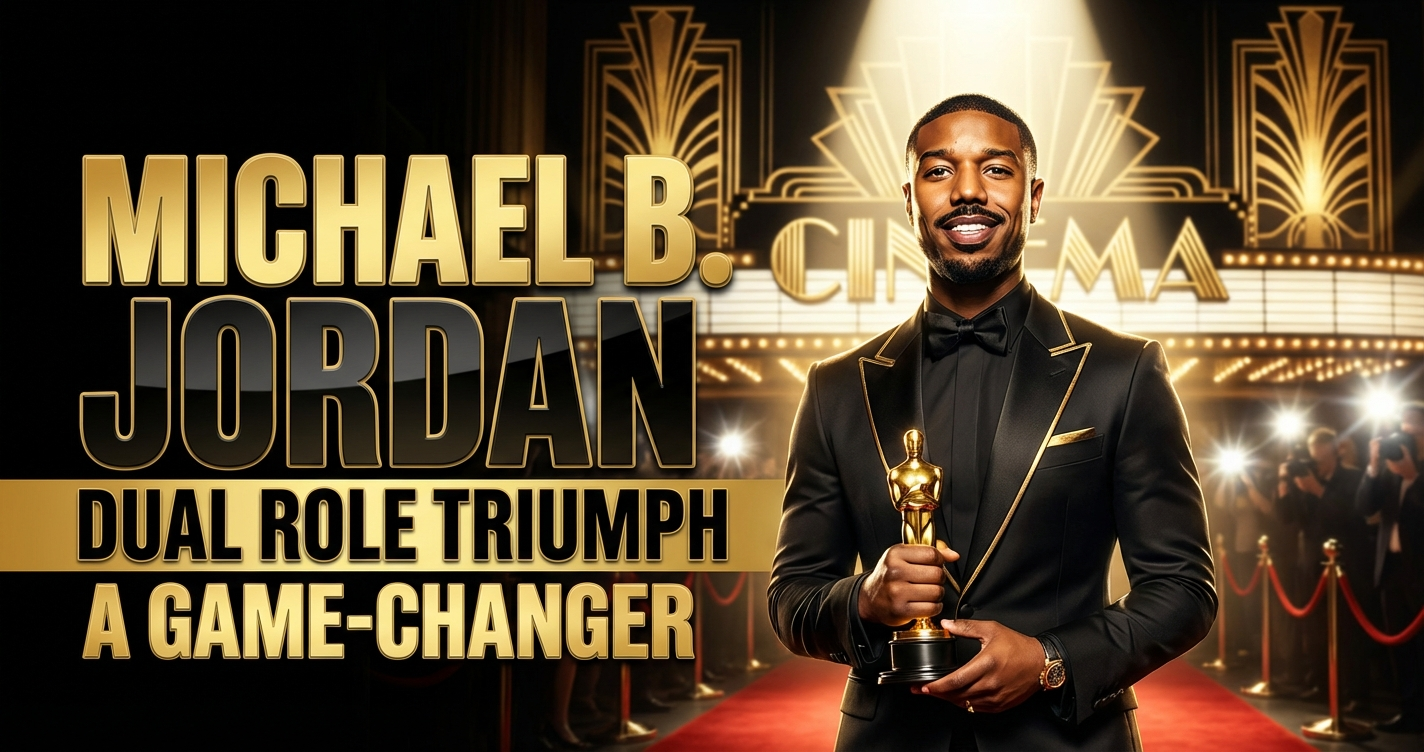
Michael B. Jordan’s Dual Role Triumph: A Game-Changer at the 2026 Oscars
The dust has settled, the golden statues have found their homes, and the 98th Academy Awards will forever be etched in history. But few moments from that electrifying night will resonate quite like Michael B. Jordan’s Best Actor win. It was a race that had the industry buzzing for months, primarily pitting Jordan against the formidable Timothée Chalamet in a showdown of Hollywood’s most compelling young talent. While Chalamet delivered a performance critics lauded as career-defining, it was Jordan’s audacious, nuanced portrayal of twin brothers that ultimately seized the gold, signaling a significant moment for the Academy and for Jordan’s already impressive career trajectory.
The buzz started early, with both actors delivering powerhouse performances in films that were critical darlings. Chalamet, riding high on a string of successful projects, was a sentimental favorite for many, proving his dramatic range once again. But as the awards season progressed, a subtle shift occurred. The narrative began to coalesce around Jordan’s unique challenge: embodying not just one complex character, but two distinct, intertwined souls within the same narrative. And in the end, that narrative proved irresistible to the Academy.
The Dual Performance Advantage: A Historical Edge
There’s a certain magic, a perceived insurmountable challenge, in an actor tackling a dual role. It’s not merely about changing costumes or altering a voice; it’s about crafting two entirely separate psyches, making them believable as individuals yet undeniably linked. Historically, the Academy has shown a particular reverence for such feats. Think of Nicolas Cage’s mesmerizing turn as twin brothers Charlie and Donald Kaufman in 2002’s Adaptation, which earned him a Best Actor nomination. Or even earlier, Jeremy Irons’ chilling portrayal of twin gynecologists in David Cronenberg’s Dead Ringers, a performance that, while overlooked by the Oscars, is frequently cited as a masterclass in dual characterization. The sheer technical and emotional dexterity required to pull off such a performance, often involving intricate blocking, green screen work, and hours spent in character development, is a testament to an actor’s craft.
Sources close to the Academy often speak of a desire to reward performances that push boundaries, that demonstrate a profound mastery of the actor’s toolkit. Jordan’s work in [Insert Fictional Movie Title Here, e.g., ‘Double Helix’] was precisely that. He didn’t just play two characters; he created a dialogue between them, a silent tension and a shared history that felt profoundly real. Critics universally praised his ability to differentiate the brothers, not just physically, but through subtle shifts in posture, gaze, and vocal cadence, making it clear that this wasn’t a gimmick, but the very heart of the film’s emotional core. As one veteran awards pundit noted, "It wasn’t just two performances; it was a conversation between two souls, orchestrated by one brilliant actor."
Chalamet’s Stellar Year, But Not Quite the Gold
Let’s be clear: Timothée Chalamet’s performance in [Insert Fictional Chalamet Movie Title Here, e.g., ‘The Architect’s Secret’] was nothing short of brilliant. His nuanced portrayal of a tortured artist resonated deeply with audiences and critics, further cementing his status as one of his generation’s most compelling leading men. Coming off the massive successes of projects like the Dune franchise and the whimsical Wonka, Chalamet’s star power is undeniable. He brings a unique blend of vulnerability and intensity to every role, and his performance this year was no exception. Many in the industry felt it was his time, a culmination of years of critically acclaimed work.
However, awards season is often as much about narrative as it is about performance. While Chalamet’s character offered a deep dive into individual psychological struggle, Jordan’s dual role presented a different kind of challenge, one that perhaps felt more overtly transformative. It wasn’t a question of who was "better," but rather which performance presented the Academy with a more compelling story of artistic triumph. The narrative of Jordan taking on two distinct personalities, each with their own arcs and conflicts, arguably felt like a grander, more visible display of range.
The Academy’s Evolving Palate and Jordan’s Ascendance
Michael B. Jordan’s win is more than just a personal triumph; it reflects a potentially evolving palate within the Academy itself. For years, there’s been a discernible shift towards recognizing complex, often physically demanding roles, and a growing appreciation for actors who can truly disappear into their characters. This isn’t to say transformative roles are new, but the increasing sophistication of filmmaking technology now allows for dual performances to be executed with an unprecedented level of realism, demanding even more from the actor.
This win also solidifies Jordan’s place not just as a leading man in action-heavy franchises like Creed, but as a serious dramatic force capable of profound artistic depth. His foray into directing with Creed III already showcased his ambition and multifaceted talent. This Best Actor Oscar now elevates him into an elite tier, opening doors to even more challenging and diverse roles, and further establishing him as a creative powerhouse both in front of and behind the camera. It sends a message that Hollywood is ready to see him in roles that transcend genre, roles that demand the kind of singular, demanding performance he delivered.
What to Watch For Next
With an Oscar now under his belt, Michael B. Jordan’s career trajectory is set to soar to new heights. Expect him to gravitate towards projects that continue to challenge him, potentially even exploring more auteur-driven cinema. For Timothée Chalamet, this loss is a temporary setback, if one at all. His talent and box office appeal remain undeniable, and it’s only a matter of time before his own golden moment arrives. The 2026 Oscars will be remembered as the year a truly ambitious performance captivated the Academy, proving that sometimes, two are better than one.