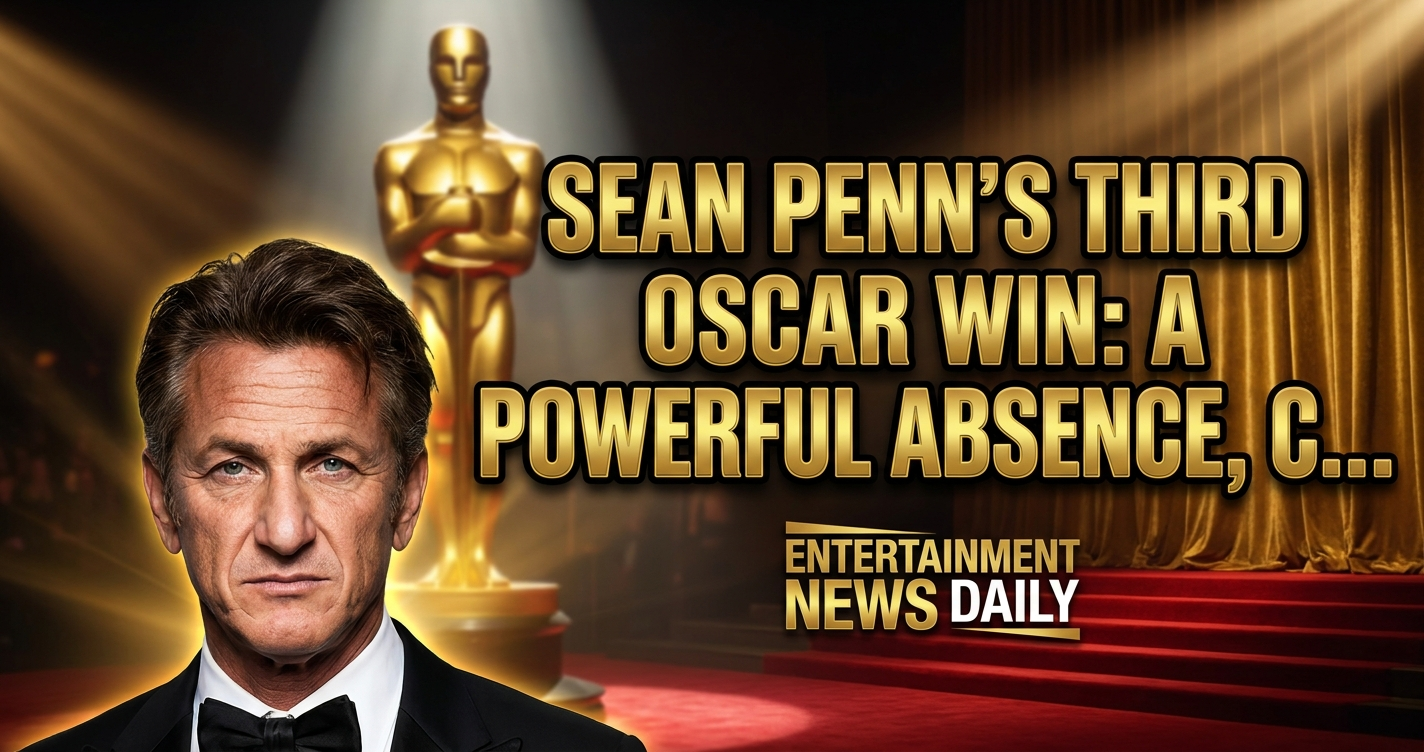
Sean Penn’s Third Oscar Win: A Powerful Absence, Kieran Culkin Steps In
The 2026 Academy Awards were meant to be a coronation. Another moment for Hollywood to celebrate its own, and for a living legend to cement his place in the pantheon. Instead, Sean Penn, ever the provocateur, delivered a masterclass in making a statement without uttering a single word. His unprecedented third Oscar win, this time for Best Supporting Actor in the gritty, resonant drama Shadow’s Edge, was marked by his conspicuous absence, leaving the stage open for a surprisingly eloquent stand-in: Kieran Culkin.
For those of us who’ve covered the industry for decades, Penn’s no-show wasn’t entirely unexpected, but its timing and context added a sharp, almost defiant edge to an otherwise celebratory evening. This wasn’t just a scheduling conflict; it felt like a deliberate act, a potent commentary from a man who has consistently prioritized his convictions over the red carpet’s glare. His win for his searing portrayal of a disillusioned journalist confronting a global crisis in Shadow’s Edge was widely praised as one of his most complex and emotionally raw performances to date, proving that even after decades, Penn remains at the peak of his formidable powers.
The Echo of a Legend: Penn’s Unconventional Path
Penn’s career is a tapestry woven with intense performances and an equally intense relationship with the public eye. His previous Best Actor wins for Mystic River (2004) and Milk (2009) were watershed moments, showcasing his chameleon-like ability to inhabit characters fully. Yet, even in those moments of triumph, Penn rarely embraced the full spectacle. He’s an artist who operates on his own terms, often using his platform to champion causes, sometimes to the industry’s discomfort. This latest absence, following a third win that places him in an elite club of multi-Oscar winners, feels like the culmination of that philosophy.
Sources close to the production of Shadow’s Edge hint that Penn had been particularly vocal during its making about the film’s thematic resonance with current geopolitical tensions. It’s not a stretch to imagine his absence was a pointed, albeit silent, protest or an act of solidarity, rather than simple disinterest. As one long-time Hollywood publicist, speaking off the record, put it, “Sean Penn doesn’t do anything by accident. His silence often speaks louder than any speech.”
Kieran Culkin: A Successor’s Poise and Wit
The true surprise of the evening, and perhaps its most charming moment, came when Kieran Culkin gracefully stepped onto the stage to accept the golden statuette on Penn’s behalf. Culkin, fresh off his Emmy-winning turn in HBO’s Succession and establishing himself as a compelling presence in film, handled the unexpected spotlight with characteristic wit and understated reverence. He reportedly relayed a message from Penn, which, while brief, was pure Penn: a simple acknowledgement of the craft, a nod to his fellow nominees, and a subtle implication that the real work was in the storytelling, not the accolades.
Culkin, known for his ability to inject humor into solemn moments, managed to defuse any potential awkwardness, turning what could have been a moment of tension into a demonstration of mutual respect. His presence on stage, embodying a younger generation of talent, felt symbolic. It was a bridge between the old guard, represented by Penn’s deliberate distance, and the new, who navigate fame with a different kind of savvy. It highlighted Culkin’s growing stature, marking him as an actor not just of immense talent, but also of considerable class.
The Oscar’s Enduring Mystique in a Changing Landscape
Penn’s decision casts a fascinating light on the evolving relationship between Hollywood’s biggest stars and its most coveted award. In an era where celebrity statements, social media, and digital engagement often overshadow the art itself, Penn’s quiet rebellion forces us to consider the true value of the Oscar. Is it a career marker, a public relations tool, or something more profound? For Penn, it seems, it’s about the work, and the message, above all else.
This isn’t the first time an Oscar winner has skipped the ceremony – Marlon Brando famously sent Sacheen Littlefeather in 1973 to decline his award in protest, and George C. Scott outright rejected his. But Penn’s absence, for a third win no less, has a different flavor. It’s less about outright rejection and more about a nuanced, powerful re-prioritization. It leaves us, the audience and the industry alike, to ponder the meaning of achievement when the loudest voice is silence itself.
What to Watch For Next: Will Penn offer further clarification on his absence, or will he let the moment speak for itself? And how will Kieran Culkin’s star continue to rise following this unexpected, yet memorable, turn in the Oscar spotlight?