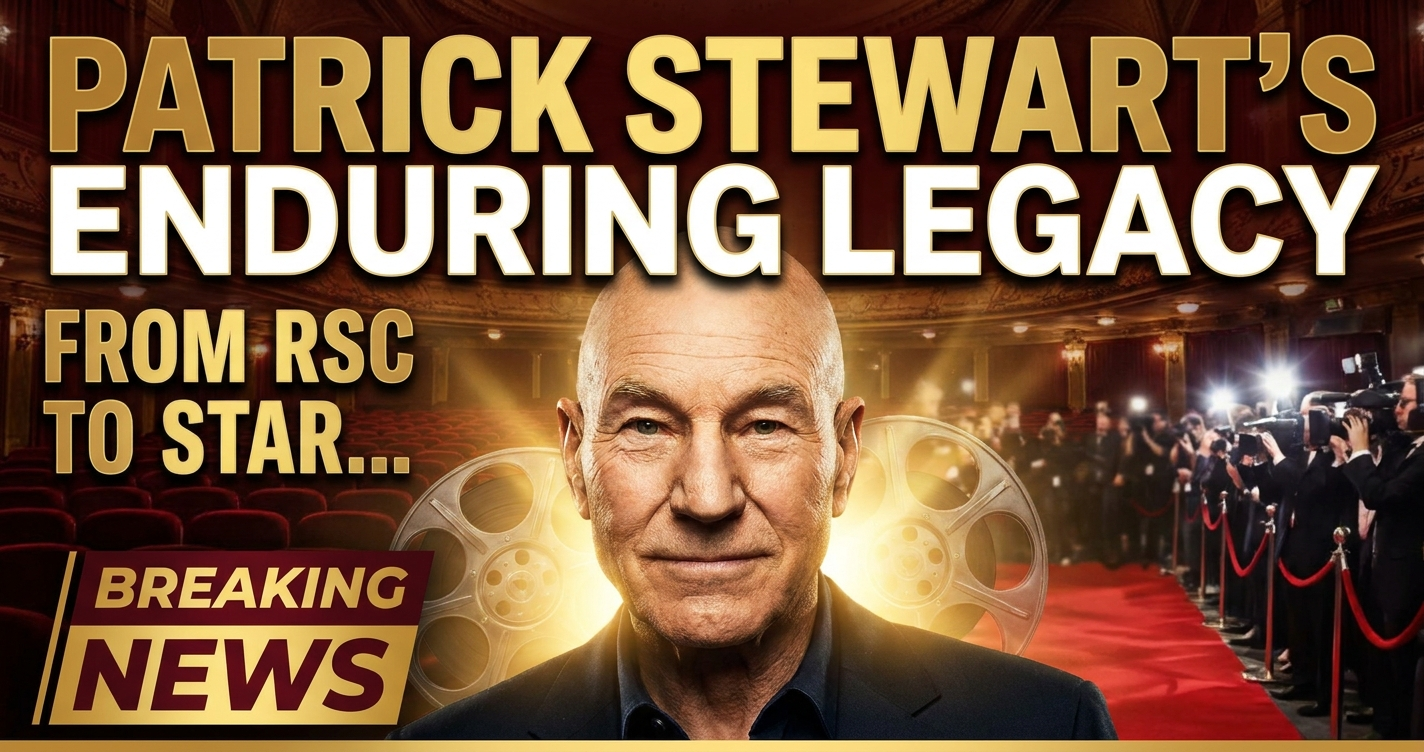
A Star’s Final Voyage: Patrick Stewart’s Impact on Stage and Screen
The entertainment world is mourning the loss of a true titan. DailyDrama.com has learned that the legendary Patrick Stewart, whose commanding presence and iconic voice graced stages and screens for over six decades, has passed away at the age of 86. His passing marks the end of an era for millions of fans who knew him as the unflappable Captain Jean-Luc Picard of Starfleet and the telepathic Professor Charles Xavier of the X-Men, roles that transcended mere acting to become cultural touchstones.
Stewart, born in Mirfield, Yorkshire, in 1940, built a career on a foundation of rigorous classical training, culminating in an illustrious tenure with the Royal Shakespeare Company. This classical gravitas, far from limiting him, became the very bedrock upon which he built an unparalleled second act as a genre icon. It’s a testament to his unique talent that he could be equally revered for his Hamlet as he was for his handling of a phaser or a mutant power. His influence redefined what a serious actor could bring to popular culture, elevating entire genres in the process.
His passing isn’t just the loss of an actor; it’s the loss of a guiding voice, a moral compass, and a performer who imbued every character with an unmistakable intelligence and dignity. The outpouring of tributes from Hollywood colleagues, fellow Trekkies, and X-Men devotees speaks volumes about the profound connection he forged with audiences worldwide.
From the Bard to the Stars: A Foundation of Gravitas
Before he was charting courses through the Delta Quadrant or mentoring young mutants, Patrick Stewart was a force to be reckoned with on the British stage. His association with the Royal Shakespeare Company (RSC) from 1966 to 1982 was not merely a stepping stone; it was the crucible that forged his distinct acting style. He tackled virtually every major Shakespearean role, from Macbeth to Shylock, earning critical acclaim and honing the vocal precision and physical command that would become his trademarks.
It was this deep understanding of character and narrative, honed by the complexities of Shakespeare, that allowed him to bring such incredible depth to his later genre roles. As industry insiders often noted, Stewart didn’t just play a character; he inhabited them with a gravitas that few could match. One could argue that without the RSC, there would be no Captain Picard as we know him – a leader whose moral authority felt earned, whose intellectual curiosity was palpable, and whose empathy resonated profoundly. This transition from high art to mainstream sci-fi was, at the time, somewhat unprecedented, yet Stewart made it seem effortless, opening doors for countless other classically trained actors to explore genre work.
Captain Picard: Redefining Sci-Fi Leadership
When Star Trek: The Next Generation premiered in 1987, many wondered if it could ever escape the shadow of the original series. Stewart’s casting as Captain Jean-Luc Picard was a gamble that paid off handsomely. Far from William Shatner’s swashbuckling Kirk, Picard was an intellectual, a diplomat, a man of profound ethics who often sought peaceful resolutions before resorting to force. Stewart brought an almost regal bearing to the role, transforming the captain’s chair into a place of philosophical debate and moral dilemma.
His performances elevated the show beyond mere space opera, tackling complex themes of artificial intelligence, human rights, and the nature of existence. It’s hard to overstate the impact of TNG, and Stewart was its undeniable anchor. His portrayal made Picard one of the most beloved and respected figures in science fiction history, inspiring a generation of fans and even real-world leaders. The character’s enduring appeal led to a triumphant return in the Star Trek: Picard series on Paramount+, a testament to how deeply ingrained Stewart’s portrayal was in the cultural zeitgeist. Even in his later years, he brought a nuanced vulnerability to Picard, showing that even the strongest leaders grapple with loss and regret.
Professor X: The Soul of the X-Men Universe
Just as he redefined sci-fi leadership, Stewart did the same for the burgeoning superhero genre. His casting as Professor Charles Xavier in 2000’s X-Men was nothing short of brilliant. Alongside Ian McKellen’s Magneto, Stewart brought a Shakespearean weight to the comic book material, grounding the fantastical elements in deeply human conflict. He wasn’t just a man in a wheelchair; he was the moral center of an embattled species, a beacon of hope and tolerance in a world that feared and hated them.
Stewart’s Professor X provided the intellectual and emotional core for arguably the first truly successful modern superhero film franchise. He lent the character an empathetic intelligence that resonated deeply, making Xavier’s dream of coexistence feel both noble and tragically fragile. His final, heart-wrenching performance in 2017’s Logan, alongside Hugh Jackman, was a masterclass in portraying vulnerability and decline, solidifying his place as an actor unafraid to expose the raw edges of even his most iconic characters. That film, in particular, showcased his immense range, proving he could still deliver profound emotional depth even while revisiting a long-held role.
Beyond the Icons: A Versatile Performer
While Captain Picard and Professor X undoubtedly defined his global stardom, Patrick Stewart’s career was far richer and more diverse. From his early film work in classics like Dune (1984) to his delightful voice work as Avery Bullock in American Dad!, he consistently showcased a remarkable versatility. He never truly left the stage, returning frequently to acclaimed productions, proving his dedication to his craft extended far beyond Hollywood’s brightest lights.
His ability to shift effortlessly from high drama to comedic timing, from profound monologues to witty one-liners, speaks volumes about his depth as an artist. He was an actor who commanded attention, not through flashy theatrics, but through the sheer force of his presence and the intelligence he brought to every line.
An Irreplaceable Presence: What He Leaves Behind
Patrick Stewart leaves behind an extraordinary legacy: a body of work that spans the classical stage, groundbreaking television, and blockbuster cinema. He was a rare talent who managed to be both a revered classical actor and a beloved pop culture icon, bridging worlds that often remain separate. He taught us that intelligence and empathy are true strengths, that leadership can be quiet and profound, and that even in the darkest futures, hope can prevail.
His impact on the entertainment industry, particularly in elevating the dramatic potential of science fiction and superhero genres, is immeasurable. Future actors stepping into the shoes of Picard or Xavier will undoubtedly face the daunting task of following in his colossal footsteps. While the curtain has fallen on his incredible career, the voyages of Captain Picard and the wisdom of Professor X, imbued with Patrick Stewart’s unique spirit, will continue to inspire and resonate for generations to come. DailyDrama.com joins the world in saluting a true legend. What will be the most enduring image of his incredible career for you?