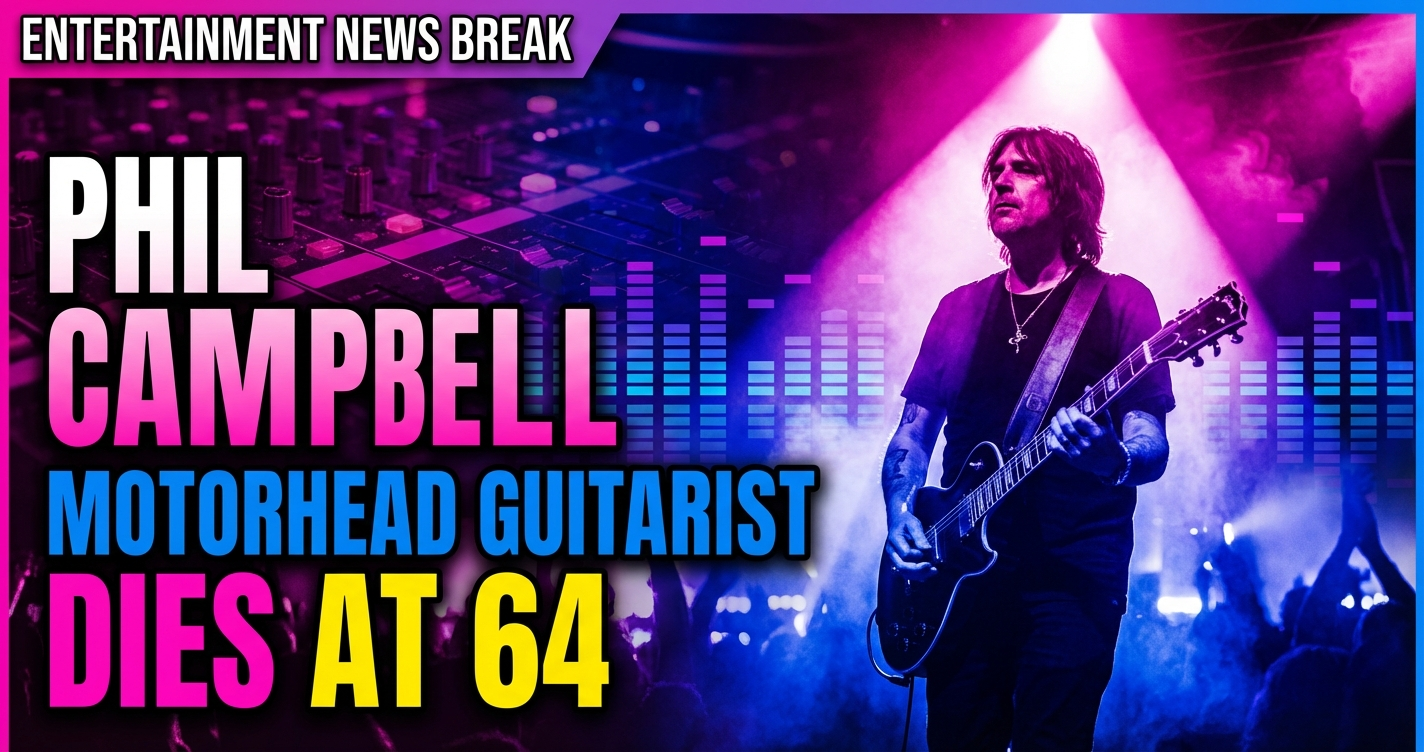
Motorhead Guitarist Phil Campbell Dies at 64: A Riff Lord’s Enduring Legacy
The lights on the grand stage of rock dimmed a little brighter this past week with the somber news out of Wales. Philip Anthony Campbell, the inimitable guitarist who anchored Motorhead’s sound for over three decades, has passed away at the age of 64. His family confirmed on March 13, 2026, that the iconic musician died in intensive care following a complex operation, a battle waged with the same ferocity he brought to his guitar.
For fans globally, it’s another gut punch, a stark reminder of the relentless march of time that continues to claim the titans of rock and roll. Campbell wasn’t just a sideman; he was the raw, unpolished engine room behind Lemmy Kilmister’s unmistakable growl, providing the scorching riffs that defined an era and a genre. His passing leaves an undeniable void, not just for his family and friends, but for every aspiring guitarist who ever tried to replicate his distinctive crunch, and for every rock enthusiast who found solace and defiance in Motorhead’s relentless sonic assault.
A Riff Lord’s Legacy with Motorhead
Campbell joined Motorhead in 1984, a pivotal moment for the band. After a brief period with two guitarists, he quickly solidified his place as the sole axe-slinger alongside Lemmy and drummer Mikkey Dee. It was a partnership that would last until Lemmy’s death in 2015, forging a sound that was uniquely Motorhead: a blistering, unholy trinity of punk aggression, heavy metal power, and rock and roll swagger.
His contributions to albums like Orgasmatron (1986), 1916 (1991), and the blistering Sacrifice (1995) are legendary. Campbell’s playing was never about flashy, over-the-top solos; it was about the groove, the feel, the sheer, undeniable force of a riff that could peel paint off walls. He possessed a rare ability to blend bluesy grit with speed and precision, creating a sound that was instantly recognizable and utterly vital to Motorhead’s identity. Industry insiders often spoke of his incredible work ethic and his unwavering dedication to the band’s no-frills, maximum-impact philosophy. He was the unsung hero who made sure the foundation was always rock-solid, allowing Lemmy to be Lemmy.
Beyond the Bomber: A New Chapter and Enduring Spirit
Following the heartbreaking dissolution of Motorhead after Lemmy’s passing, many wondered if Campbell would retreat from the spotlight. Instead, he did what all true rock and rollers do: he kept playing. He launched Phil Campbell and the Bastard Sons, a triumphant, multi-generational project that saw him sharing the stage with his own sons, Todd, Dane, and Tyla. This venture wasn’t just a tribute; it was a vibrant continuation of his musical journey, showcasing his enduring passion and his ability to evolve while staying true to his roots.
The Bastard Sons released acclaimed albums like The Age of Absurdity (2018) and We’re the Bastards (2020), proving that Campbell still had plenty of fire in his belly and riffs to spare. It was a beautiful testament to the power of family and the unbreakable bond of music, a narrative that resonated deeply within the industry and with fans who cherished his refusal to fade away. It underscored a growing trend in the music world: legacy artists finding new avenues to create and perform, often with younger generations, bridging gaps and keeping their sound alive.
The Unending Toll on Rock’s Pantheon
Campbell’s passing, sadly, adds to a growing list of rock legends we’ve lost in recent years. From Lemmy himself, to David Bowie, Chris Cornell, Eddie Van Halen, and countless others, the titans of the classic rock era are leaving us at an alarming rate. It serves as a stark reminder of the toll that decades of touring, relentless schedules, and the sheer physicality of rock and roll can take on even the most robust individuals. The music industry, for all its glamour, is a demanding mistress, and these artists gave their all, often pushing their bodies to the limit for their craft.
For the fans, each loss feels deeply personal. These musicians weren’t just performers; they were the soundtrack to our lives, the voices of rebellion, comfort, and camaraderie. Their music is an indelible part of our collective cultural fabric, and the industry grapples with how to honor these legacies while simultaneously nurturing the next generation of artists. The passing of someone like Campbell sparks conversations about preserving the history of rock, the importance of archival efforts, and how to introduce these iconic sounds to new audiences.
Phil Campbell was more than a guitarist; he was a cornerstone of one of the most uncompromising bands in rock history, a dedicated father, and a musician who lived and breathed his craft until the very end. His riffs will continue to reverberate, his spirit of no-nonsense rock and roll will inspire, and his legacy is firmly etched into the annals of heavy metal. While we mourn his physical absence, his music, like all true art, is eternal.
What to watch for next? Expect a surge in streaming and sales of Motorhead’s catalog, as fans revisit Campbell’s essential contributions. There will undoubtedly be tributes from across the rock spectrum, and the future of Phil Campbell and the Bastard Sons will be a poignant question for fans and industry observers alike.