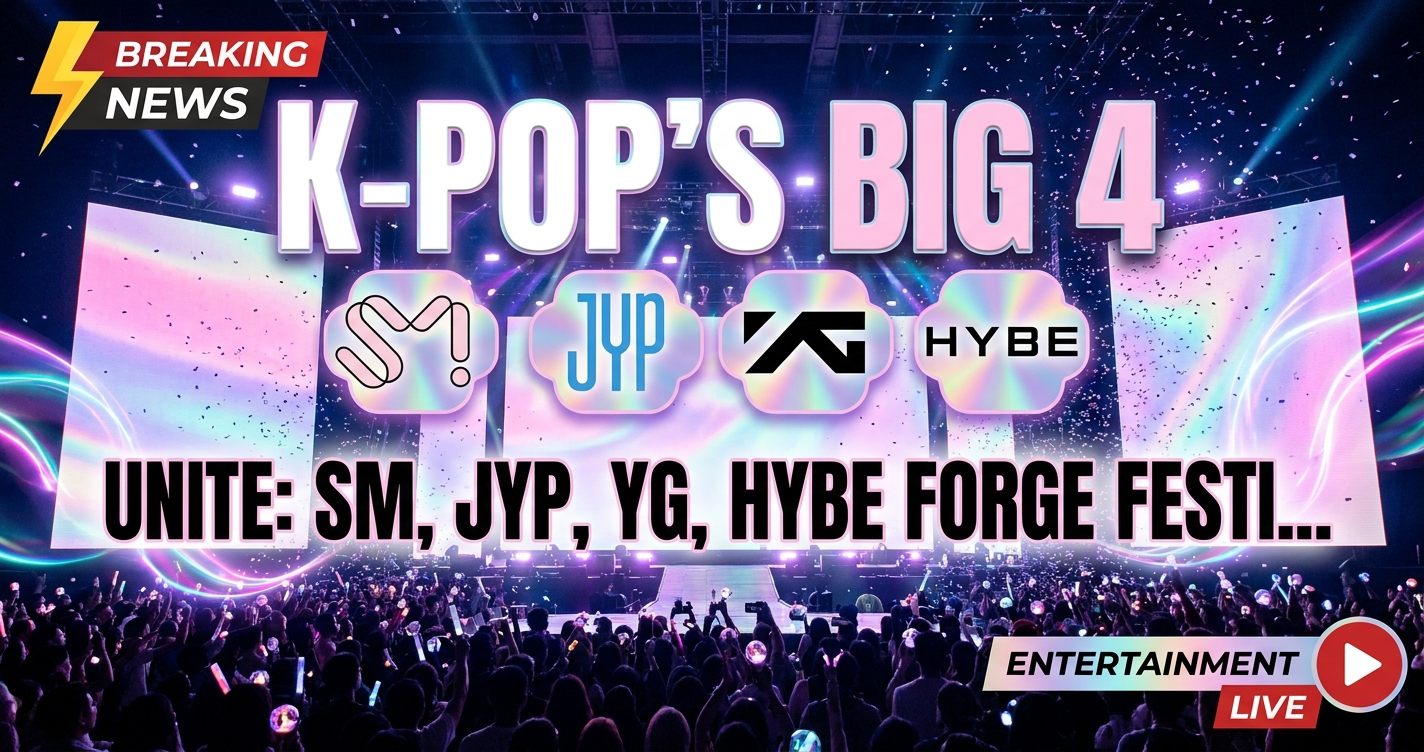
In an announcement that has sent seismic waves through the global entertainment industry, K-Pop’s most powerful agencies—SM Entertainment, JYP Entertainment, YG Entertainment, and HYBE Corporation—are reportedly joining forces to launch an unprecedented joint venture for a global K-Pop festival. This isn’t just big news; it’s a tectonic shift, marking a historical coming together of fierce rivals who have, for decades, battled for supremacy in the highly competitive K-Pop landscape.
For those of us who’ve watched K-Pop evolve from a niche phenomenon to a global cultural juggernaut, the idea of these four titans—the ‘Big 3’ (SM, JYP, YG) and the disruptor-turned-titan HYBE—collaborating on such a grand scale is almost unfathomable. It’s akin to Marvel and DC co-producing a blockbuster, or Coca-Cola and Pepsi launching a joint beverage. The implications for the future of K-Pop, its global reach, and the fan experience are nothing short of monumental.
From Fierce Rivals to Collaborative Powerhouses
To truly grasp the magnitude of this alliance, one must understand the history. For decades, SM, JYP, and YG were the undisputed pillars of K-Pop, each cultivating distinct musical styles, training methodologies, and fan bases. SM Entertainment, the veteran, pioneered the idol group system with acts like H.O.T. and Girls’ Generation. JYP Entertainment brought its own flavor of pop with Wonder Girls and TWICE, while YG Entertainment carved out a hip-hop-influenced niche with Big Bang and BLACKPINK. Their competition was not just healthy; it was often intense, driving innovation and pushing boundaries.
Then came HYBE (formerly Big Hit Entertainment), a smaller agency that, against all odds, propelled BTS to unprecedented global superstardom, reshaping the industry’s power dynamics. HYBE’s rise challenged the established order, proving that global success wasn’t exclusive to the ‘Big 3’. In recent years, the rivalry has only escalated, with each agency striving to expand its global footprint, develop new talent, and engage fans through various platforms and content.
So, why this sudden pivot to collaboration? An industry insider, speaking on condition of anonymity, suggested to DailyDrama.com that the move is a pragmatic recognition of K-Pop’s current global status. “Individually, they are immensely powerful,” the source explained, “but together, they can create something truly unparalleled, a festival that transcends national boundaries and consolidates K-Pop’s position on the world stage like never before.” It’s a strategic play to leverage collective resources, mitigate risks, and maximize global impact.
The Global K-Pop Imperative: Why Now?
K-Pop is no longer a niche genre; it’s a dominant force in popular culture. Its artists headline major international events, top global charts, and command a devoted, passionate fan base spanning continents. Yet, despite this global prominence, there hasn’t been a single, definitive global K-Pop festival that truly captures the genre’s collective power and diversity.
While each of these agencies has successfully hosted its own massive concerts and fan gatherings—from SM Town Live to JYP Nation, YG Family concerts, and HYBE’s Weverse Con—a joint venture promises an entirely different scale. Imagine a lineup featuring artists from EXO, NCT, aespa (SM), Stray Kids, ITZY, NMIXX (JYP), TREASURE, BABYMONSTER (YG), and of course, the full HYBE roster including BTS members (solo), SEVENTEEN, TXT, ENHYPEN, and LE SSERAFIM. The sheer star power would be astronomical, drawing crowds and attention that individual agencies might struggle to achieve alone.
This initiative also comes at a time when the live music industry is booming post-pandemic, with fans more eager than ever for immersive experiences. Major festivals like Coachella, Lollapalooza, and Glastonbury are global institutions. A K-Pop festival backed by the Big 4 has the potential to join these ranks, becoming a pilgrimage site for millions of fans worldwide. It’s about solidifying K-Pop’s cultural footprint and creating a tentpole event that defines the genre annually.
Navigating the Waters: Challenges and Opportunities
While the potential rewards are immense, the road ahead is undoubtedly complex. Merging the corporate cultures, artistic visions, and fan bases of four distinct entertainment behemoths will be a monumental task. Questions immediately arise: How will artist lineups be balanced? Who gets headline slots? How will profit sharing and creative control be managed? Will existing rivalries among fandoms spill over, or will the spirit of collaboration foster greater unity?
A veteran concert promoter we spoke with expressed cautious optimism: “The logistics alone are mind-boggling, but if they can truly put aside their competitive instincts for the collective good, this could be a blueprint for future industry collaboration. The opportunity to tap into each other’s global networks and production expertise is unparalleled.”
Beyond the internal dynamics, the venture will need to carefully consider global fan demographics, potential host cities, and the digital experience for those unable to attend in person. This isn’t just about putting idols on a stage; it’s about crafting a comprehensive, technologically advanced, and culturally sensitive event that resonates with K-Pop’s diverse global audience.
What to Watch For Next
The announcement of this joint venture marks a new chapter for K-Pop. DailyDrama.com will be closely watching for further details on the festival’s branding, initial lineup announcements, and host cities. More importantly, we’ll be tracking how these historically competitive entities manage to coalesce their visions and resources. Will this unprecedented alliance truly usher in a new era of industry synergy, or will the inherent challenges prove too great? The stakes are incredibly high, and the world is watching to see if K-Pop’s biggest players can truly unite to deliver the ultimate global music experience.