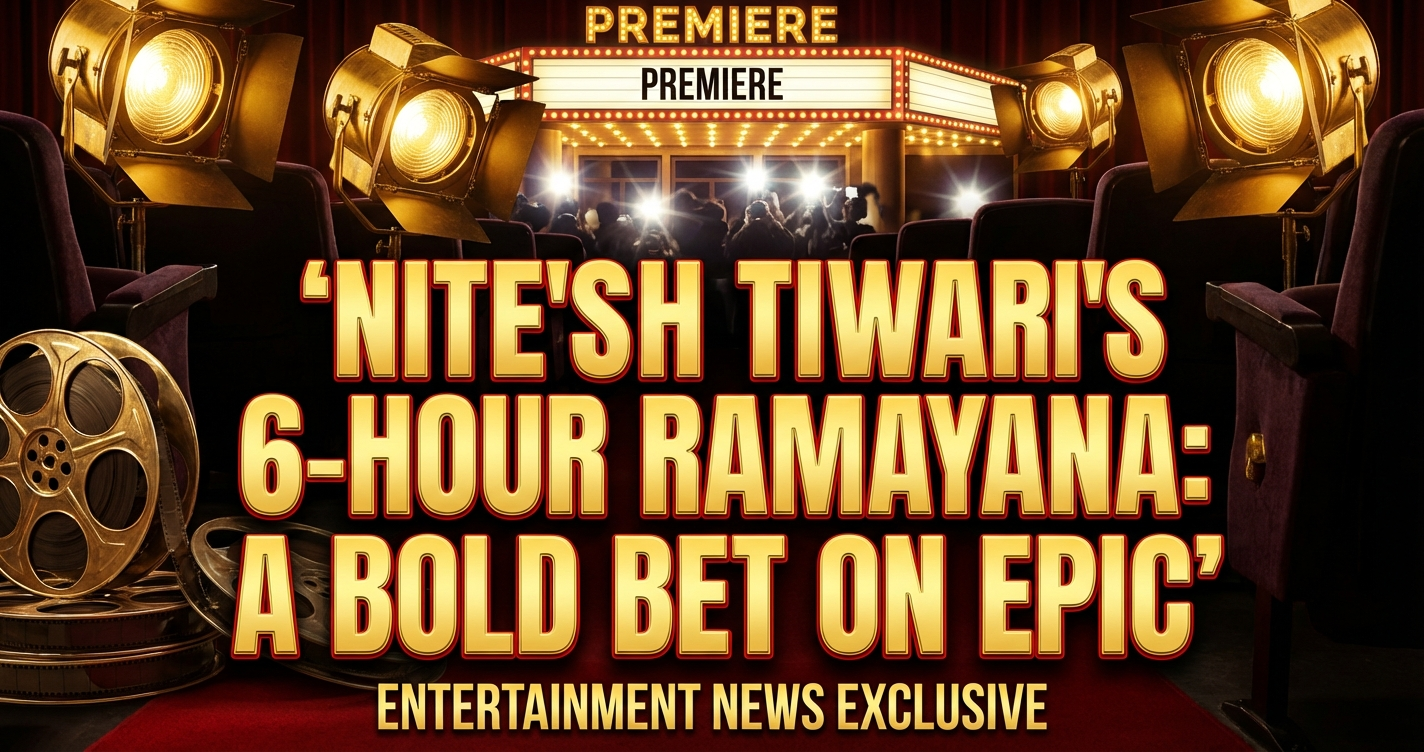
Is a 6-Hour ‘Ramayana’ a Game-Changer or a Gamble?
The murmurs from industry insiders are growing louder, and if true, Nitesh Tiwari’s ambitious adaptation of the Hindu epic, Ramayana, starring Ranbir Kapoor as Lord Ram, is shaping up to be a cinematic event unlike any other. The latest buzz isn’t about the stellar cast or the reported colossal budget, but its rumored runtime: a staggering six hours. In an era where attention spans are supposedly shrinking, is this an act of directorial bravado or a shrewd understanding of what today’s audiences truly crave?
For years, the conventional wisdom in Bollywood dictated that a film exceeding three hours was a theatrical liability. Producers would often trim narratives to fit multiplex schedules, fearing audience fatigue. Yet, recent history offers a compelling counter-narrative. S.S. Rajamouli’s magnum opus, Baahubali: The Beginning and Baahubali 2: The Conclusion, proved unequivocally that length is no barrier when the narrative is gripping, the visuals are breathtaking, and the emotional core resonates. Combined, these two parts offered over five hours of immersive storytelling, captivating millions globally and rewriting box office records. Viewers didn’t just tolerate the length; they celebrated it, demanding more.
The Epic Gamble: Length as an Asset, Not a Liability
The success of multi-part sagas like Baahubali, K.G.F., and Pushpa has fundamentally shifted the paradigm. These films, often released in two parts, train audiences to invest in extended narratives. The theatrical experience transforms from a quick diversion into a momentous event, akin to binging a high-quality limited series on a streaming platform. Industry analysts suggest that in the age of streaming, where viewers routinely consume ten-hour seasons in a weekend, the idea of a single, albeit long, theatrical film no longer feels insurmountable. “Audiences are primed for deeper dives,” an industry veteran told DailyDrama.com, speaking on condition of anonymity. “They want to live in these worlds, and if a story like Ramayana truly warrants six hours to do it justice, they will show up.”
This perspective suggests that Tiwari isn’t defying convention, but rather embracing an evolving audience palate. The Ramayana is not just a story; it’s a cultural cornerstone, a saga of immense depth and spiritual significance. To compress its vastness into a standard two-and-a-half-hour format would risk trivializing its essence, leaving out crucial character arcs, philosophical nuances, and epic battles that demand grand scale.
Nitesh Tiwari’s Midas Touch and the Weight of an Epic
The man at the helm, Nitesh Tiwari, is no stranger to crafting compelling narratives that resonate deeply. His filmography boasts critically acclaimed and commercially successful ventures like Dangal, a powerful biopic that transcended sports drama, and Chhichhore, a poignant take on friendship and life’s pressures. Tiwari has a knack for balancing grand themes with intimate emotional beats, a skill that will be paramount in navigating the sprawling canvas of Ramayana.
However, adapting the Ramayana comes with immense pressure. It’s not just a film; it’s an interpretation of a revered text that holds profound meaning for millions. Every character, every dialogue, every visual choice will be scrutinized. Sources close to the production indicate that Tiwari’s vision is to create an immersive, respectful, yet contemporary retelling that honors the epic’s legacy while appealing to a global audience. The reported six-hour runtime is, therefore, not merely a choice of indulgence but a narrative necessity to fully flesh out the journey of Lord Ram, Sita (Sai Pallavi), Raavan (Yash), and the myriad characters that populate this universe.
Crafting Immersion: The Challenge of Sustained Engagement
While the potential for an epic experience is undeniable, the challenge of sustaining audience engagement for six consecutive hours in a darkened cinema hall is formidable. Pacing will be key. Tiwari will need to meticulously craft the narrative flow, ensuring moments of intense drama, breathtaking action, and poignant reflection are strategically placed to avoid fatigue. Veteran film critic and historian, Ms. Anya Sharma, commented recently, “It’s not just about having a great story; it’s about how you tell it when you have that much time. Every scene must earn its place. Think of the sustained tension in a film like Lagaan, which was nearly four hours long, or the sheer visual ambition of the two-part Gangs of Wasseypur. Tiwari has to hit that sweet spot.”
The production, backed by a massive budget, is reportedly leveraging cutting-edge VFX and production design to bring the mythical world of Ayodhya, Lanka, and Kishkindha to life. This visual spectacle, combined with a powerful score and the gravitas of its lead actors, will be crucial in keeping audiences glued to their seats. The film is envisioned as a multi-part saga, but the current buzz points to a single, extended theatrical release for the first installment, potentially with intermissions.
What’s Next for the Grandest Epic?
Nitesh Tiwari’s Ramayana is poised to be more than just a film; it could redefine the scope of Indian cinema. The reported six-hour runtime is a statement of intent – a commitment to profound, unhurried storytelling. If Tiwari and his team succeed in delivering a captivating narrative that justifies its grand length, they won’t just have a blockbuster on their hands, but a cultural phenomenon that could set new benchmarks for epic adaptations globally. All eyes will be on the first trailer, the official runtime announcement, and how this ambitious vision truly unfolds on the big screen. The cinematic battle is just beginning, and DailyDrama.com will be tracking every development.