Quentin Tarantino Ignites Debate: Is Hollywood a ‘Flavorless Sausage Factory’?
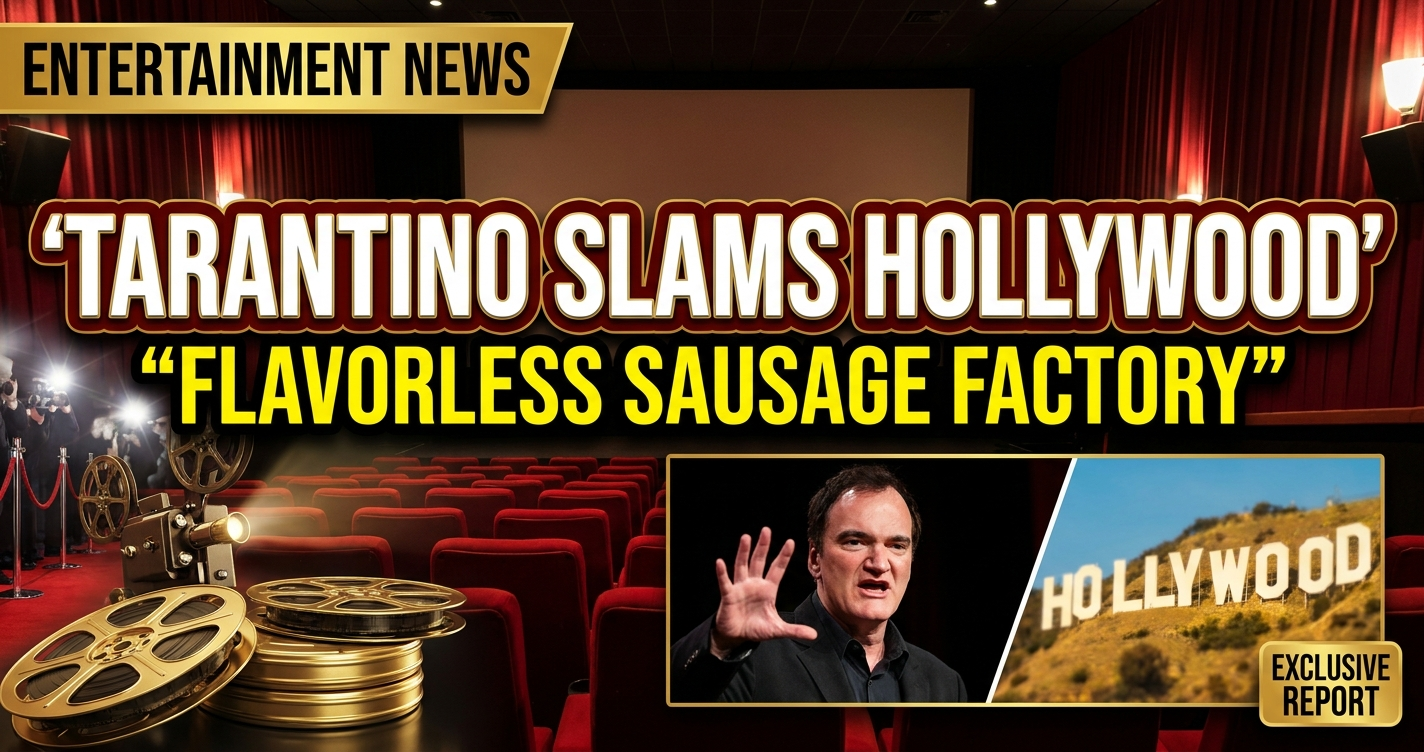
Quentin Tarantino, a director whose name is synonymous with audacious originality and uncompromising vision, has once again fired a broadside at the state of modern Hollywood. In a recent, characteristically blunt assessment, the auteur behind classics like Pulp Fiction and Once Upon a Time in Hollywood didn’t hold back, labeling the industry a "flavorless sausage factory" where "miscast" actors, "audience pandering," or "stupid s— torpedoes every new movie." Coming from a filmmaker who has consistently defied convention and maintained a singular voice over three decades, these remarks carry significant weight, sparking a conversation that has long simmered beneath the surface of the entertainment world.
Tarantino’s critique isn’t just a casual dismissal; it’s a pointed indictment of a system he believes prioritizes formula over genuine artistry. He’s not alone in this sentiment, as many industry veterans and cinephiles have quietly, or sometimes loudly, voiced similar concerns. But Tarantino’s outspoken nature, coupled with his legendary status, amplifies the message, forcing a closer look at the mechanisms driving today’s blockbusters and streaming content.
The ‘Sausage Factory’ Mentality: IP Over Innovation
The "flavorless sausage factory" metaphor cuts deep. It speaks to a perceived homogenization of content, where unique voices and risky projects are increasingly sidelined in favor of known quantities. Studios, under immense pressure to deliver consistent returns, often lean heavily on established intellectual property (IP) – sequels, prequels, reboots, and cinematic universes – a strategy that, while financially lucrative, can lead to creative stagnation. We’ve seen an unprecedented proliferation of interconnected franchises, from superhero sagas to nostalgic revivals, which, while offering comfort and familiarity, rarely push the boundaries of storytelling.
This trend isn’t entirely new. Hollywood has always had its cycles of formulaic productions. However, the scale and dominance of this IP-driven model in the streaming era feel particularly pervasive. Directors like Martin Scorsese have famously likened certain franchise films to "theme parks," arguing they diminish the art of cinema. Francis Ford Coppola has echoed similar sentiments, lamenting the industry’s focus on "the same movie over and over." Tarantino’s comments resonate with these earlier critiques, suggesting the problem has only intensified.
Miscasting: When Star Power Trumps Suitability
One of Tarantino’s most intriguing points focuses on "miscast" actors. In an era where casting decisions can be heavily influenced by an actor’s social media following, global appeal, or ability to ‘open’ a film, the pure suitability for a role sometimes takes a backseat. Studios might push for a bankable star, even if their inherent persona or acting style clashes with the character’s essence, hoping their name alone will draw audiences.
Tarantino, conversely, is renowned for his brilliant and often unexpected casting choices – resuscitating careers (John Travolta in Pulp Fiction), elevating character actors to leading roles (Christoph Waltz in Inglourious Basterds), or simply finding the perfect, sometimes lesser-known, fit. His films thrive on the authenticity and chemistry of their ensembles, a testament to the power of precise casting. When an actor is miscast, it can indeed torpedo a film, undermining credibility and breaking the audience’s immersion, no matter how strong the underlying script.
Audience Pandering and the ‘Stupid S—‘ Factor
The accusation of "audience pandering" speaks to the increasingly risk-averse nature of major studio productions. Focus groups, test screenings, and demographic targeting can lead to films being watered down, stripped of their sharper edges, or engineered to appeal to the widest possible "four-quadrant" audience. The result is often a lowest common denominator approach, where narrative complexity and challenging themes are sacrificed for broad, inoffensive appeal.
This pursuit of universal appeal can inadvertently lead to the "stupid s—" Tarantino references – plots that defy logic, dialogue that feels artificial, and resolutions that are overly simplistic. The fear of alienating any segment of the audience can stifle bold storytelling, leading to a glut of predictable, paint-by-numbers cinema that lacks genuine emotional resonance or intellectual stimulation. In an age of endless content, standing out often requires taking risks, not playing it safe.
What’s Next for Hollywood and Tarantino?
Tarantino’s comments serve as a powerful, albeit harsh, mirror for Hollywood. While the industry continues to churn out blockbusters and innovative television, his critique highlights a genuine concern about the overall creative health of mainstream cinema. As Tarantino himself prepares for what he has stated will be his tenth and final film, The Movie Critic, his voice becomes even more significant – a celebrated filmmaker reflecting on the legacy and future of the medium he so deeply loves.
Will Hollywood heed his words? Or will the "flavorless sausage factory" continue to operate at full capacity? The challenge for studios, filmmakers, and audiences alike is to champion originality, embrace diverse storytelling, and perhaps, re-evaluate what truly constitutes cinematic art in the modern age. We’ll be watching closely to see if Tarantino’s provocative statements spark any meaningful shifts, or if they remain just another voice in the wilderness of a rapidly evolving industry.