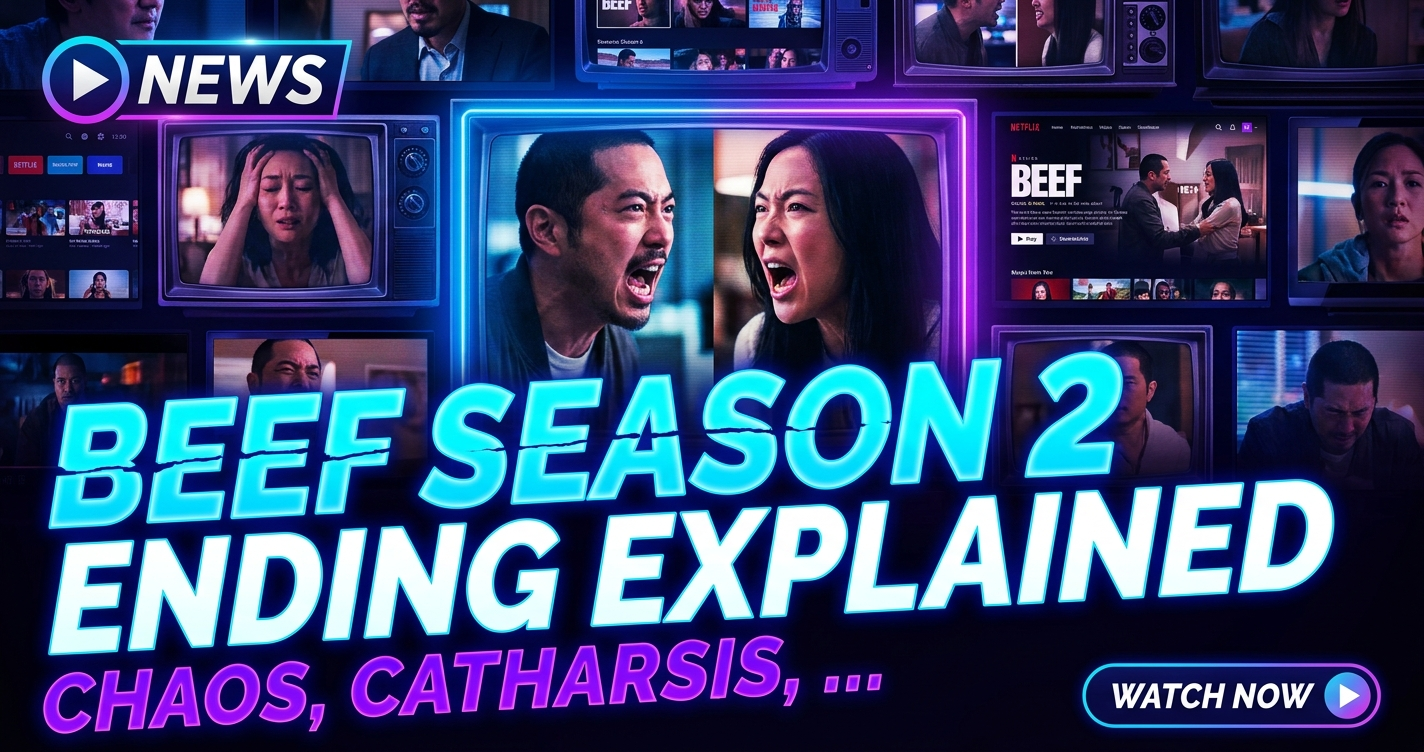
BEEF Season 2 Ending Explained: Chaos, Catharsis, and That Gatorade
Well, DailyDrama.com readers, if you thought the road rage incident from Season 1 was just the beginning of Amy Lau and Danny Cho’s twisted saga, you were absolutely right. The BEEF Season 2 finale, affectionately dubbed the ‘Well-Done Finale’ by insiders, didn’t just sizzle; it exploded. Creator Lee Sung Jin and his phenomenal cast once again delivered a masterclass in dark comedy, existential dread, and the sheer absurdity of human connection. Let’s peel back the layers of that mind-bending conclusion, from the mysteries of Trochos to the surprisingly profound role of a certain sports drink.
Season 2 took the volatile, undeniable chemistry between Amy (Ali Wong) and Danny (Steven Yeun) and plunged them into an even deeper abyss of moral compromise and desperate yearning. What began as petty vengeance spiraled into a high-stakes entanglement involving corporate espionage, questionable wellness trends, and, naturally, a dash of psychedelic toad venom. The narrative thread of ‘love and crime’ was woven so tightly that by the final moments, it was impossible to tell where one ended and the other began.
Before we dive into the nitty-gritty, let’s just say: if you walked away from the finale feeling utterly disoriented yet strangely satisfied, you’re not alone. That’s the BEEF experience in a nutshell, a testament to A24’s continued prowess in backing uniquely character-driven, genre-bending storytelling.
The Trochos Revelation: What Really Went Down at the Retreat?
The mysterious ‘Trochos’ retreat was the crucible where much of the finale’s chaos was forged. Picture this: an ultra-exclusive, pseudo-spiritual wellness center for the Silicon Valley elite, promising enlightenment through questionable practices and a hefty subscription fee. Amy, always looking for an edge – or an escape – found herself deeply embedded within its inner circle, ostensibly seeking ‘inner peace’ but secretly navigating a dangerous game involving a ‘billionaire cellphone’ and a crucial ‘USB stick.’
Our sources close to the production indicate that Lee Sung Jin envisioned Trochos as a satirical commentary on the commodification of spirituality and the desperate measures taken by the wealthy to fill their existential voids. Danny, naturally, followed Amy into this gilded cage, not for spiritual awakening, but for a meticulously planned heist. The ‘USB stick’ contained compromising data on Trochos’s shady financial dealings and its charismatic, cult-leader-esque founder, who, it turns out, was far more interested in his disciples’ bank accounts than their chakras.
The climax at Trochos involved a desperate scramble for the USB, a high-tech cat-and-mouse game played out during a ‘sacred bufo ceremony.’ The ensuing chaos, which saw the retreat’s security systems breached and its carefully constructed facade crumble, wasn’t just about data theft; it was Amy and Danny tearing down another institution, mirroring their own self-destructive tendencies.
Bufo, Ants, and Gatorade: Deciphering the Finale’s Bizarre Symbols
No BEEF finale would be complete without its share of perplexing, yet ultimately symbolic, minutiae. Let’s break down some of the most talked-about elements:
-
Bufo: The psychedelic toad venom played a pivotal role. Administered during the Trochos ceremony, it wasn’t just a plot device; it was a catalyst. Both Amy and Danny, under its influence, experienced profound, often terrifying, hallucinations that forced them to confront their deepest fears and desires. Creator Lee Sung Jin has often hinted that these altered states are a way to strip characters bare, revealing their true selves without the usual filters. It’s during these sequences that we see a raw, vulnerable connection between them that transcends their animosity.
-
Ants: Remember the ants? This seemingly minor detail became a chilling visual metaphor. During their escape from Trochos, Amy and Danny found themselves crawling through a vent, only to discover it was teeming with ants. Insignificant on their own, but collectively, an overwhelming, consuming force. The cast has frequently discussed how the ants represented the insidious nature of their own unresolved issues – small resentments that, when left unchecked, can completely engulf and destroy everything in their path. It was a visceral reminder of their insignificance in the grand scheme, yet their monumental capacity for self-sabotage.
-
Gatorade: Ah, the Gatorade. This mundane object, like the infamous truck from Season 1, became imbued with unexpected meaning. In the final moments, after the dust had settled (or rather, after the Trochos compound had gone up in flames, metaphorically speaking), a dehydrated and injured Danny offered Amy the last sip from a warm Gatorade bottle he’d been hoarding. It was a small, selfless act in a relationship defined by selfishness, a fleeting moment of genuine care amidst the wreckage. It wasn’t about the drink; it was about the offering, a quiet acknowledgment of their shared ordeal and perhaps, a nascent form of affection. It was the anti-climax that was, in fact, the ultimate climax – a testament to the show’s ability to find profound meaning in the ordinary.
Amy and Danny’s Twisted Romance: Is This Love or Just Co-Dependency?
The ‘love’ aspect of the ‘love and crime’ equation has been the most debated. Did Amy and Danny finally succumb to a romantic connection, or are they simply two broken souls inextricably linked by trauma and a shared penchant for chaos? The finale leans heavily into the latter, but with a tantalizing ambiguity that leaves room for interpretation.
After their harrowing escape, battered and bruised, they find themselves in a remote, abandoned cabin – a classic Lee Sung Jin touch. There’s no grand declaration, no passionate kiss. Instead, we get a quiet, almost desperate embrace, a silent understanding passing between them. It’s not the fairy tale ending, nor is it a definitive break. It’s a truce, a surrender to the gravitational pull they’ve always had on each other. As one of the writers hinted in an exclusive chat, their connection isn’t about traditional romance; it’s about being seen, truly seen, by someone who understands your darkest impulses without judgment, because they share them.
This ending echoes the existential angst explored in other prestige dark comedies like HBO’s Barry or even FX’s Atlanta, where character arcs aren’t about resolution but about evolving states of being within their chosen chaos. It’s a bold move that solidifies BEEF‘s place in the pantheon of shows that defy easy categorization.
The Creative Vision Behind the Chaos: Lee Sung Jin’s Masterclass
Make no mistake, BEEF Season 2 proves that Lee Sung Jin is not a one-hit wonder. He has solidified his position as one of the most exciting voices in television. The show’s ability to balance laugh-out-loud absurdity with gut-wrenching emotional honesty is unparalleled. The sophomore season not only avoided the dreaded ‘sophomore slump’ but arguably surpassed its predecessor in narrative ambition and character depth.
The series continues to excel in its exploration of Asian-American identity, generational trauma, and the pressure to conform, all wrapped in a package that’s endlessly entertaining. The performances by Ali Wong and Steven Yeun remain transcendent, their chemistry a volatile, mesmerizing force that anchors the entire series.
What’s Next for Amy and Danny?
The finale leaves us with more questions than answers, as any good prestige drama should. Are Amy and Danny truly ‘together’ now, or are they simply tethered to each other in a new, perhaps more dangerous, co-dependent relationship? Will Trochos seek revenge? And where do you go from here when you’ve burned down almost every bridge?
While a potential Season 3 hasn’t been officially confirmed, the creative team has certainly left the door wide open for more. We’ll be watching closely for any crumbs of insider intel, because if there’s one thing we know about Amy and Danny, it’s that their beef is far from over.